

The Bulls' Direction Problem Shows Up in the Rotation


With Jalen Smith out, Billy Donovan adjusted his starting lineup Thursday night against the Cleveland Cavaliers, moving Collin Sexton and Nick Richards into the group and sending Leonard Miller out.
The decision stood out less because of the matchup and more because of a recent trend.
Miller had started the previous five games, carving out a larger role in the process. Moving him back to the bench, even with Cleveland adjusting its rotation and playing without Donovan Mitchell and Jarrett Allen, represented a reset rather than a routine shuffle.
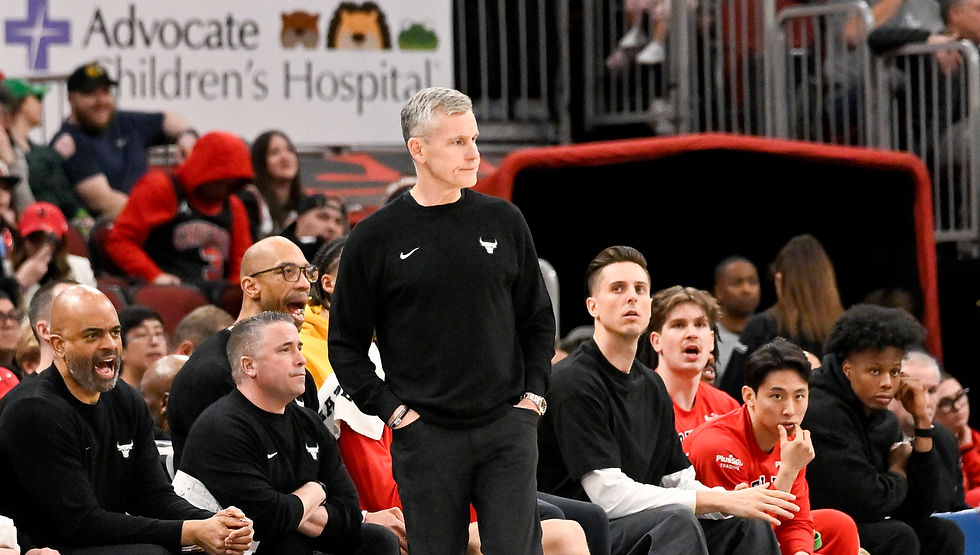
Still, it fit a familiar pattern of Donovan prioritizing structure and leaning on what he believes gives the Bulls the best chance to win possession by possession.
For six seasons, that approach has defined how he’s coached in Chicago.
What’s not clear is whether the context around him has kept pace.
Not long after the trade deadline, Donovan said something that still feels relevant.
“I think we’ve got to sit down as an organization, quite honestly — myself, ownership, the front office — and just find the direction and the clarity.”
Six weeks later, that clarity still isn’t fully visible in how the team is operating.
At 223–247 over his tenure, Donovan has rarely been in a position where alignment matters more, or where direction from above and decisions on the floor feel more disconnected.
Because the Bulls did change.
At the trade deadline, Artūras Karnišovas reshaped the roster, moving out established players and bringing in a wave of younger, less proven pieces. The moves suggested a pivot away from the version of the team Donovan had been coaching.
But the mandate behind those moves hasn’t translated to how the team is being coached night to night.
“Everything I’ve gotten from the front office has been about going out there and competing, trying to win,” Donovan has said.
So he continues to coach the game in front of him. Thursday provided another example that.
After shifting out of the starting lineup, Miller played a little over 19 minutes and closed the game, logging extended fourth-quarter run as the Bulls mounted a comeback attempt.
It was a sustained opportunity late in a meaningful game, the kind of stretch that offers a clearer look at how a player responds when possessions matter.
Rob Dillingham had a similarly steady outing, finishing with 17 points on efficient shooting along with four rebounds, an assist, a steal, and no turnovers in 21 minutes.
Taken together, the performances from Miller and Dillingham weren’t isolated developments. They were part of a rotation still taking shape, still absorbing new players, and still operating without a clearly defined long-term hierarchy.
That uncertainty showed up in the margins.
Donovan’s approach doesn’t exclude younger players when the game tightens.
Instead, it filters opportunity through trust built over time and performance in the moment. When a player earns it, the minutes can follow — even late in competitive games.
But that process still exists within a framework oriented toward winning each night.
And that’s where the broader tension lives.
The Bulls are trying to evaluate a roster that has been significantly reshaped. At the same time, they are competing in games where outcomes still matter, and where rotations tend to reflect short-term stability more than long-term exploration.
On Thursday, that balance nearly produced a result that underscored both sides of that equation at once.
Donovan’s job is to navigate those margins in real time. He hasn’t been asked to deprioritize winning, nor has he been given a mandate to fully shift toward development.
That hasn’t changed.
What has changed is the roster around him, and the questions that now come with it.
Six seasons in, Donovan remains steady in his approach as the Bulls continue working toward a clearer sense of what this stretch is supposed to accomplish.
Thursday night didn’t answer those questions.
It added another example — a lineup adjustment, a rotation that shifted in response, and a fourth quarter where a younger player stayed on the floor long enough to show that opportunity, while not guaranteed, is not entirely fixed.
The Bulls are still competing.
Donovan is still coaching.
And the space between those two realities is where the rest of this season unfolds.


Comments