

The Bulls Aren't Tanking. They're Losing With Principles.

The Association has never been subtle about what it rewards.
When a draft offers players capable of bending a franchise’s arc, the league’s worst teams don’t stumble into position — they manage their way there.
Availability becomes flexible. Timelines stretch. Fourth quarters are optional. Competitive integrity becomes a talking point precisely because it’s no longer the point.
Flattened lottery odds were meant to discourage excess. Instead, they’ve refined it. Losing is no longer about certainty. It’s about signaling intent.
Around the league, teams have been clear-eyed about what that posture requires.

In Washington, the Wizards acquired Trae Young and Anthony Davis and promptly removed them from their ecosystem. Young hasn’t played in six weeks, with no public timetable. Davis was sent back to Dallas with a recovery timeline that’s increased by four weeks.
In Utah, Jaren Jackson Jr. has spent fourth quarters on the bench, alongside Lauri Markkanen, since joining the Jazz.
Indiana traded for Ivica Zubac and almost immediately discovered a sore ankle — and the pressing responsibilities of new fatherhood.
None of this is accidental. Tanking, some say. Strategic asset management, say others.
Which brings us to the Chicago Bulls.
Even with Josh Giddey, Tre Jones and Jalen Smith sidelined, the Bulls stick to structure.
At the trade deadline, they finally took their foot off the gas. Coby White and Nikola Vučević were moved, along with Ayo Dosunmu and Kevin Huerter.
The roster that remains is thinner, younger, and far less capable of winning by accident.
Since then, the Bulls have lost three straight games — and yet, they are not tanking.
They are competing earnestly.
Around the league, teams manipulate availability to protect position.
Brooklyn, in a game against the Bulls, held out Michael Porter Jr. and rested 20-year-old rookie Egor Demin.
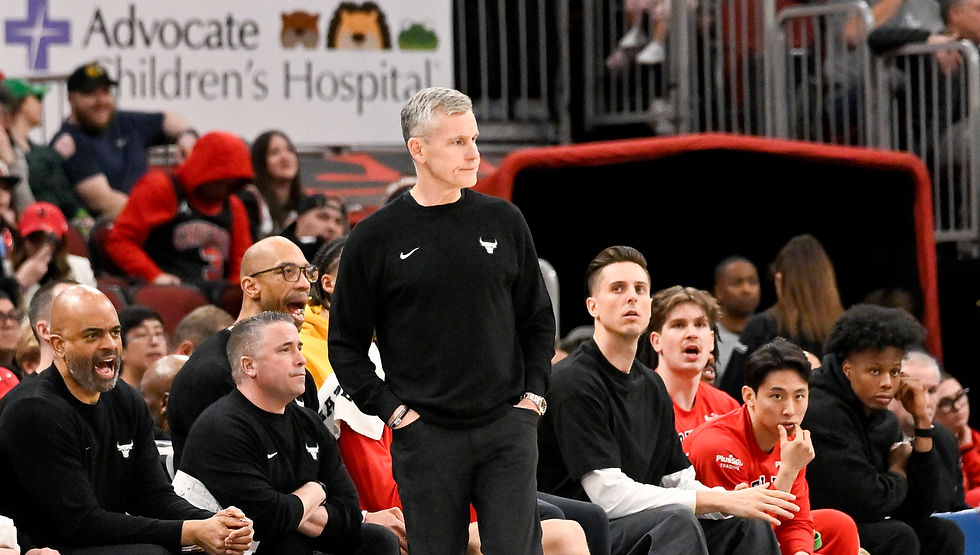
Even in the limited sample since the deadline, Billy Donovan has defaulted to veterans in crunch time, trusting structure and experience over developmental upside.
The deadline signaled a pivot. The rotation has not.
This is where the Bulls separate themselves from the rest of the league. Not because they are above tanking — but because they refuse to acknowledge what the moment typically demands.
Donovan coaches the game in front of him. He trusts veterans. He protects structure. Competitive integrity isn’t a slogan. It’s his lifeblood.
In most seasons, that approach is admirable.
In this one, it’s quietly absurd.
Across the league, teams are clear about what losing now can buy them later.
Meanwhile, the Bulls stick to a standard that no longer aligns with incentives — competing in key moments, managing rotations, respecting the game — even when the season’s goal has shifted.
This isn’t strategic losing.
It’s losing in a suit and tie.
For years, the Bulls have avoided extremes, preferring the middle ground. Now, even as they inch toward a reset, that instinct remains.
The roster has changed. The direction has shifted. But the habits — the reflex to compete first and contextualize later — are still intact.
Everyone else is gaming the system.
The Bulls are still trying to pass the class.
They aren’t tanking. They’re performing competitive integrity. Nightly. Earnestly. Without irony — in a league that has already moved on from pretending effort and incentives are the same thing.
And once again, the Bulls appear to settle into a familiar space — structurally sound, strategically unresolved.
In a league that rewards clarity, the Bulls remain committed to effort — even when clarity would serve them better.


Comments