

Even When They Can Breathe, the Bulls Don't
- Drew Stevens (@Drew_H_Stevens)

- Jan 19
- 3 min read
The Chicago Bulls rarely have room to breathe. And when they get it, they don’t trust it.
Sunday’s matchup offered that setup, with the Brooklyn Nets choosing to rest Michael Porter Jr. after already beating the Bulls two too many times for a team that's mostly thinking about draft math.
The Bulls gained control of the game early and never looked back. Unlike last week against Utah, the Bulls didn't need heroics to win.
What changed was the scoreboard. What didn’t was the structure.
In a game that never demanded urgency, the Bulls treated urgency as a constant. Rotations stayed compact. Veterans remained central. Dalen Terry played briefly, then waited until late to return, joined only then by Julian Phillips and Lachlan Olbrich. The margin existed, but it didn’t unlock anything new.
That consistency is the point.
Terry, Phillips, and Olbrich aren’t rotation fixtures, nor are they central to the team’s future. Their minutes matter only as indicators. On a night when three rotation players were unavailable, the opponent was undermanned, and the game never tightened, even the deepest edges of the rotation barely moved.
There was something quietly revealing about that. Even in a game that never demanded urgency, the Bulls treated urgency as a constant.
“If you look around the league, most nights it’s going to be close games,” Coby White said. “We know, at this point in the year, we’re gonna be in a lot of close games. So we have to figure out ways to win those games.”
Even after a near wire-to-wire win, the frame of reference remained survival. The Bulls are built to function under pressure, not to explore when it eases.
That identity has served them well. The Bulls are comfortable in late-game chaos. It has kept them competitive. It has also defined them.
Because even when the game hints at separation, they rarely create enough of it to change their behavior. Mistakes still feel costly. Leads still feel provisional. The pressure they’ve learned to endure stays close.
That isn’t an accident of execution. It’s a feature of construction.
The Bulls are neither explosive enough to overwhelm opponents nor poor enough to fall away early. Most nights, they hover. Veterans make that possible.
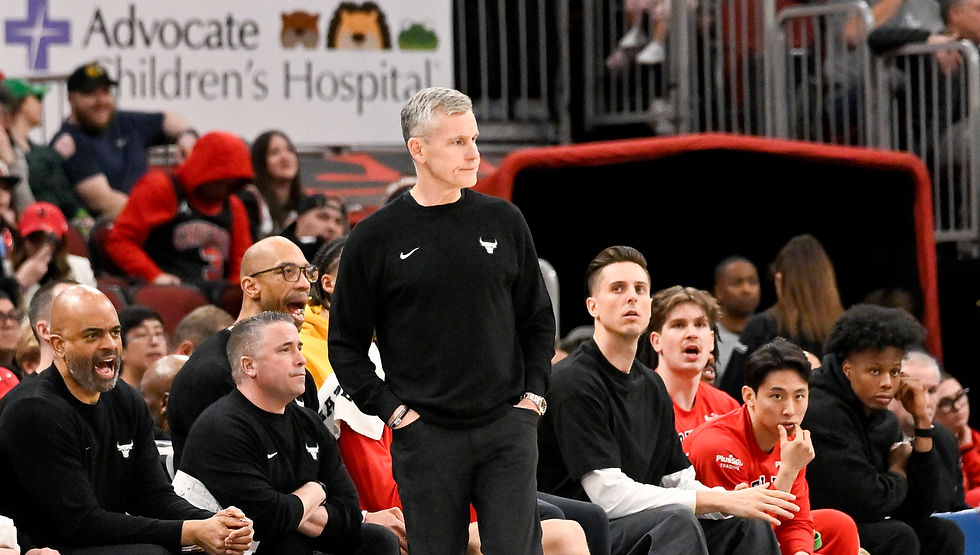
Before the game, Billy Donovan framed those margins as structural rather than symptomatic. Asked whether the Bulls’ constant presence in clutch situations reflects late-game execution or a failure to separate earlier, he pointed to league-wide parity.
“Roughly half your games in the NBA are gonna be decided within five points,” he said. “Sometimes it’s really, really hard to separate.”
He isn’t wrong. The league lives there. Most teams do. The Bulls, more than most, have learned how to operate inside that space.
Postgame, Donovan acknowledged the tension that comes with managing even a rare cushion. Even with the score in hand, the focus remained on rhythm, fatigue, and readiness.
“These games change quickly,” he said. “A lot of times you want to give guys an opportunity to play, but as the game’s going on you’re trying to make the decisions in that moment that are best for the group.”
That instinct is what defines this team. The Bulls are always managing the possibility of collapse, even on nights when the floor never tilts.
Sunday didn’t change who they are. It didn’t need to.
Even with room to breathe, the Bulls stayed the same.


Comments